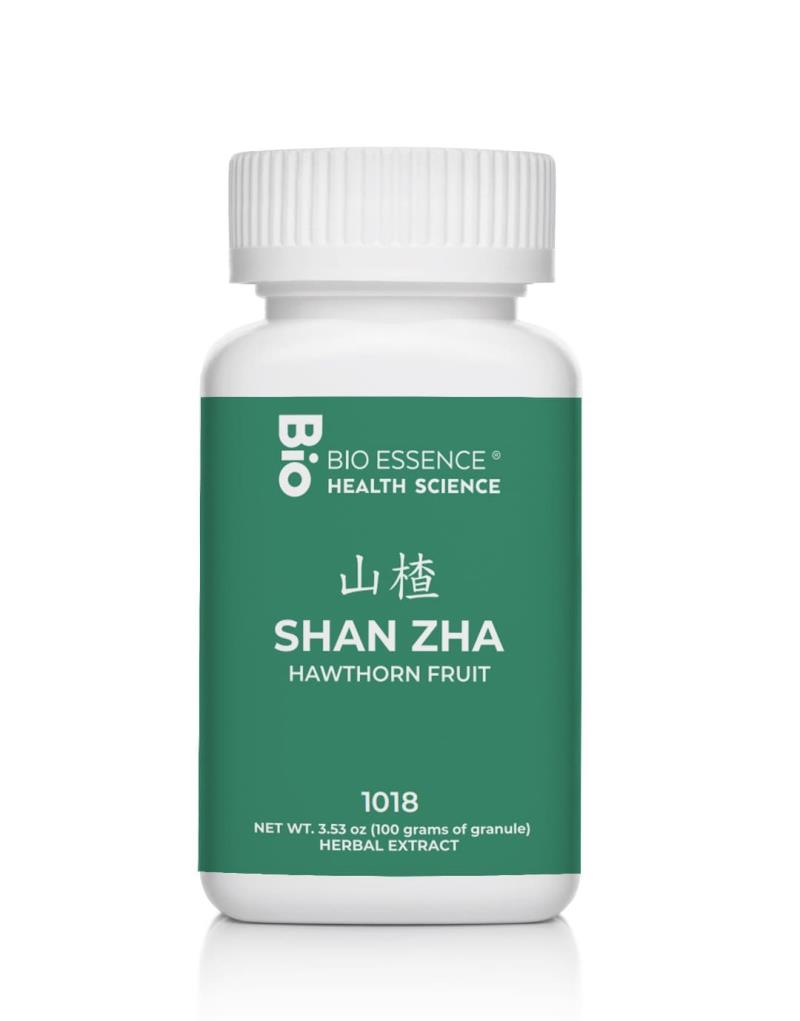
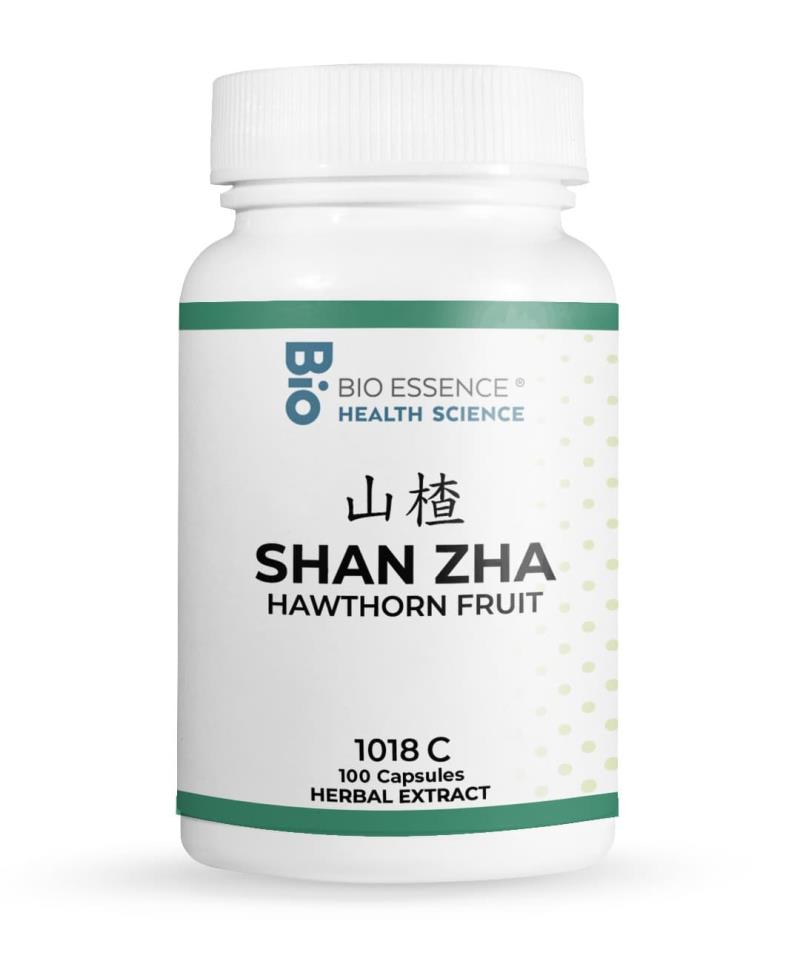

Promote digestion and dissipate food stagnation, activate blood, and resolve stasis.
Liver, Spleen, Stomach
Description:
The ripe fruit of the deciduous shrub or small arbor plant Crataegus Pinnatifida. It is sweet and sour in taste, slightly warm in nature, and can promote digestion and dissipate food stagnation. It can be used for kinds of food stagnation syndrome especially the syndrome caused by improper eating meat and fat. For meat stagnation manifested as gastric and abdominal distension, belching and acid regurgitation, abdominal pain, and loose stool, it can be decocted alone or combined with other digestant herbs such as Lai Fu Zi and Shen Qu. In addition, it can be used for abdominal pain due to diarrhea and dysentery, and colic pain. For abdominal pain due to diarrhea and dysentery, the charred one is used alone or with Mu Xiang and Bing Lang. For colic pain, it is combined with the qi-regulating, nodulation-dissipating herbs, and analgesic such as Ju He and Li Zhi He, etc. It is also indicated for coronary heart disease (CHD), hypertension, hyperlipemia, and dysentery.
BE1018/1018C
Brand
Long Description
Name: Chinese Hawthorn (山楂)
Pinyin: Shan Zha
Pharm. Name: Fructus Crataegi
Properties:
Taste
Characteristics
Organs
Sour, Sweet
Promote digestion and dissipate food stagnation, activate blood, and resolve stasis.
Liver, Spleen, Stomach
Description:
The ripe fruit of the deciduous shrub or small arbor plant Crataegus Pinnatifida. It is sweet and sour in taste, slightly warm in nature, and can promote digestion and dissipate food stagnation. It can be used for kinds of food stagnation syndrome especially the syndrome caused by improper eating meat and fat. For meat stagnation manifested as gastric and abdominal distension, belching and acid regurgitation, abdominal pain, and loose stool, it can be decocted alone or combined with other digestant herbs such as Lai Fu Zi and Shen Qu. In addition, it can be used for abdominal pain due to diarrhea and dysentery, and colic pain. For abdominal pain due to diarrhea and dysentery, the charred one is used alone or with Mu Xiang and Bing Lang. For colic pain, it is combined with the qi-regulating, nodulation-dissipating herbs, and analgesic such as Ju He and Li Zhi He, etc. It is also indicated for coronary heart disease (CHD), hypertension, hyperlipemia, and dysentery.
Bio Essence Health Science
Unit Size
Long Description
Name: Chinese Hawthorn (山楂)
Pinyin: Shan Zha
Pharm. Name: Fructus Crataegi
Properties:
Taste
Characteristics
Organs
Sour, Sweet
Promote digestion and dissipate food stagnation, activate blood, and resolve stasis.
Liver, Spleen, Stomach
Description:
The ripe fruit of the deciduous shrub or small arbor plant Crataegus Pinnatifida. It is sweet and sour in taste, slightly warm in nature, and can promote digestion and dissipate food stagnation. It can be used for kinds of food stagnation syndrome especially the syndrome caused by improper eating meat and fat. For meat stagnation manifested as gastric and abdominal distension, belching and acid regurgitation, abdominal pain, and loose stool, it can be decocted alone or combined with other digestant herbs such as Lai Fu Zi and Shen Qu. In addition, it can be used for abdominal pain due to diarrhea and dysentery, and colic pain. For abdominal pain due to diarrhea and dysentery, the charred one is used alone or with Mu Xiang and Bing Lang. For colic pain, it is combined with the qi-regulating, nodulation-dissipating herbs, and analgesic such as Ju He and Li Zhi He, etc. It is also indicated for coronary heart disease (CHD), hypertension, hyperlipemia, and dysentery.
100 Gram bottle / 100 Caps bottle
Extract Ratio
Long Description
Name: Chinese Hawthorn (山楂)
Pinyin: Shan Zha
Pharm. Name: Fructus Crataegi
Properties:
Taste
Characteristics
Organs
Sour, Sweet
Promote digestion and dissipate food stagnation, activate blood, and resolve stasis.
Liver, Spleen, Stomach
Description:
The ripe fruit of the deciduous shrub or small arbor plant Crataegus Pinnatifida. It is sweet and sour in taste, slightly warm in nature, and can promote digestion and dissipate food stagnation. It can be used for kinds of food stagnation syndrome especially the syndrome caused by improper eating meat and fat. For meat stagnation manifested as gastric and abdominal distension, belching and acid regurgitation, abdominal pain, and loose stool, it can be decocted alone or combined with other digestant herbs such as Lai Fu Zi and Shen Qu. In addition, it can be used for abdominal pain due to diarrhea and dysentery, and colic pain. For abdominal pain due to diarrhea and dysentery, the charred one is used alone or with Mu Xiang and Bing Lang. For colic pain, it is combined with the qi-regulating, nodulation-dissipating herbs, and analgesic such as Ju He and Li Zhi He, etc. It is also indicated for coronary heart disease (CHD), hypertension, hyperlipemia, and dysentery.
5:1
Taste
Long Description
Name: Chinese Hawthorn (山楂)
Pinyin: Shan Zha
Pharm. Name: Fructus Crataegi
Properties:
Taste
Characteristics
Organs
Sour, Sweet
Promote digestion and dissipate food stagnation, activate blood, and resolve stasis.
Liver, Spleen, Stomach
Description:
The ripe fruit of the deciduous shrub or small arbor plant Crataegus Pinnatifida. It is sweet and sour in taste, slightly warm in nature, and can promote digestion and dissipate food stagnation. It can be used for kinds of food stagnation syndrome especially the syndrome caused by improper eating meat and fat. For meat stagnation manifested as gastric and abdominal distension, belching and acid regurgitation, abdominal pain, and loose stool, it can be decocted alone or combined with other digestant herbs such as Lai Fu Zi and Shen Qu. In addition, it can be used for abdominal pain due to diarrhea and dysentery, and colic pain. For abdominal pain due to diarrhea and dysentery, the charred one is used alone or with Mu Xiang and Bing Lang. For colic pain, it is combined with the qi-regulating, nodulation-dissipating herbs, and analgesic such as Ju He and Li Zhi He, etc. It is also indicated for coronary heart disease (CHD), hypertension, hyperlipemia, and dysentery.
Sour
Sweet
Properties
Long Description
Name: Chinese Hawthorn (山楂)
Pinyin: Shan Zha
Pharm. Name: Fructus Crataegi
Properties:
Taste
Characteristics
Organs
Sour, Sweet
Promote digestion and dissipate food stagnation, activate blood, and resolve stasis.
Liver, Spleen, Stomach
Description:
The ripe fruit of the deciduous shrub or small arbor plant Crataegus Pinnatifida. It is sweet and sour in taste, slightly warm in nature, and can promote digestion and dissipate food stagnation. It can be used for kinds of food stagnation syndrome especially the syndrome caused by improper eating meat and fat. For meat stagnation manifested as gastric and abdominal distension, belching and acid regurgitation, abdominal pain, and loose stool, it can be decocted alone or combined with other digestant herbs such as Lai Fu Zi and Shen Qu. In addition, it can be used for abdominal pain due to diarrhea and dysentery, and colic pain. For abdominal pain due to diarrhea and dysentery, the charred one is used alone or with Mu Xiang and Bing Lang. For colic pain, it is combined with the qi-regulating, nodulation-dissipating herbs, and analgesic such as Ju He and Li Zhi He, etc. It is also indicated for coronary heart disease (CHD), hypertension, hyperlipemia, and dysentery.
Slight Warm
適用於
Long Description
Name: Chinese Hawthorn (山楂)
Pinyin: Shan Zha
Pharm. Name: Fructus Crataegi
Properties:
Taste
Characteristics
Organs
Sour, Sweet
Promote digestion and dissipate food stagnation, activate blood, and resolve stasis.
Liver, Spleen, Stomach
Description:
The ripe fruit of the deciduous shrub or small arbor plant Crataegus Pinnatifida. It is sweet and sour in taste, slightly warm in nature, and can promote digestion and dissipate food stagnation. It can be used for kinds of food stagnation syndrome especially the syndrome caused by improper eating meat and fat. For meat stagnation manifested as gastric and abdominal distension, belching and acid regurgitation, abdominal pain, and loose stool, it can be decocted alone or combined with other digestant herbs such as Lai Fu Zi and Shen Qu. In addition, it can be used for abdominal pain due to diarrhea and dysentery, and colic pain. For abdominal pain due to diarrhea and dysentery, the charred one is used alone or with Mu Xiang and Bing Lang. For colic pain, it is combined with the qi-regulating, nodulation-dissipating herbs, and analgesic such as Ju He and Li Zhi He, etc. It is also indicated for coronary heart disease (CHD), hypertension, hyperlipemia, and dysentery.
Promote digestion and dissipate food stagnation, activate blood, and resolve stasis.
Liver, Spleen, Stomach
Description:
The ripe fruit of the deciduous shrub or small arbor plant Crataegus Pinnatifida. It is sweet and sour in taste, slightly warm in nature, and can promote digestion and dissipate food stagnation. It can be used for kinds of food stagnation syndrome especially the syndrome caused by improper eating meat and fat. For meat stagnation manifested as gastric and abdominal distension, belching and acid regurgitation, abdominal pain, and loose stool, it can be decocted alone or combined with other digestant herbs such as Lai Fu Zi and Shen Qu. In addition, it can be used for abdominal pain due to diarrhea and dysentery, and colic pain. For abdominal pain due to diarrhea and dysentery, the charred one is used alone or with Mu Xiang and Bing Lang. For colic pain, it is combined with the qi-regulating, nodulation-dissipating herbs, and analgesic such as Ju He and Li Zhi He, etc. It is also indicated for coronary heart disease (CHD), hypertension, hyperlipemia, and dysentery.
Promote digestion and dissipate food stagnation, activate blood, and resolve stasis.
Liver, Spleen, Stomach
Description:
The ripe fruit of the deciduous shrub or small arbor plant Crataegus Pinnatifida. It is sweet and sour in taste, slightly warm in nature, and can promote digestion and dissipate food stagnation. It can be used for kinds of food stagnation syndrome especially the syndrome caused by improper eating meat and fat. For meat stagnation manifested as gastric and abdominal distension, belching and acid regurgitation, abdominal pain, and loose stool, it can be decocted alone or combined with other digestant herbs such as Lai Fu Zi and Shen Qu. In addition, it can be used for abdominal pain due to diarrhea and dysentery, and colic pain. For abdominal pain due to diarrhea and dysentery, the charred one is used alone or with Mu Xiang and Bing Lang. For colic pain, it is combined with the qi-regulating, nodulation-dissipating herbs, and analgesic such as Ju He and Li Zhi He, etc. It is also indicated for coronary heart disease (CHD), hypertension, hyperlipemia, and dysentery.
Promote digestion and dissipate food stagnation
Activate blood and resolve stasis
Channels Entered
Long Description
Name: Chinese Hawthorn (山楂)
Pinyin: Shan Zha
Pharm. Name: Fructus Crataegi
Properties:
Taste
Characteristics
Organs
Sour, Sweet
Promote digestion and dissipate food stagnation, activate blood, and resolve stasis.
Liver, Spleen, Stomach
Description:
The ripe fruit of the deciduous shrub or small arbor plant Crataegus Pinnatifida. It is sweet and sour in taste, slightly warm in nature, and can promote digestion and dissipate food stagnation. It can be used for kinds of food stagnation syndrome especially the syndrome caused by improper eating meat and fat. For meat stagnation manifested as gastric and abdominal distension, belching and acid regurgitation, abdominal pain, and loose stool, it can be decocted alone or combined with other digestant herbs such as Lai Fu Zi and Shen Qu. In addition, it can be used for abdominal pain due to diarrhea and dysentery, and colic pain. For abdominal pain due to diarrhea and dysentery, the charred one is used alone or with Mu Xiang and Bing Lang. For colic pain, it is combined with the qi-regulating, nodulation-dissipating herbs, and analgesic such as Ju He and Li Zhi He, etc. It is also indicated for coronary heart disease (CHD), hypertension, hyperlipemia, and dysentery.
Liver
Spleen
Stomach
Instructions
Long Description
Name: Chinese Hawthorn (山楂)
Pinyin: Shan Zha
Pharm. Name: Fructus Crataegi
Properties:
Taste
Characteristics
Organs
Sour, Sweet
Promote digestion and dissipate food stagnation, activate blood, and resolve stasis.
Liver, Spleen, Stomach
Description:
The ripe fruit of the deciduous shrub or small arbor plant Crataegus Pinnatifida. It is sweet and sour in taste, slightly warm in nature, and can promote digestion and dissipate food stagnation. It can be used for kinds of food stagnation syndrome especially the syndrome caused by improper eating meat and fat. For meat stagnation manifested as gastric and abdominal distension, belching and acid regurgitation, abdominal pain, and loose stool, it can be decocted alone or combined with other digestant herbs such as Lai Fu Zi and Shen Qu. In addition, it can be used for abdominal pain due to diarrhea and dysentery, and colic pain. For abdominal pain due to diarrhea and dysentery, the charred one is used alone or with Mu Xiang and Bing Lang. For colic pain, it is combined with the qi-regulating, nodulation-dissipating herbs, and analgesic such as Ju He and Li Zhi He, etc. It is also indicated for coronary heart disease (CHD), hypertension, hyperlipemia, and dysentery.
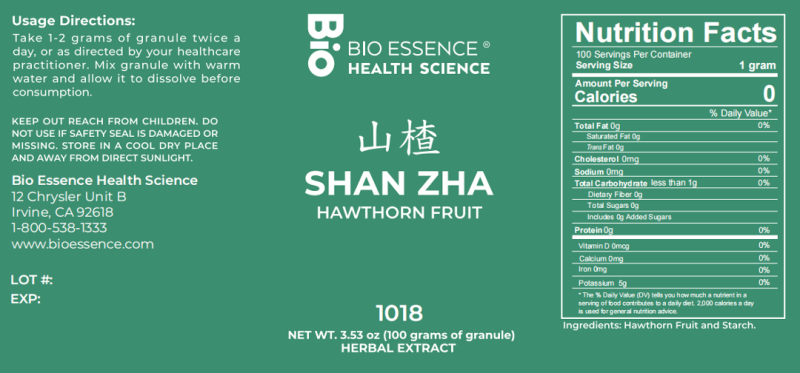
Take 1-2 grams of granules or 2-4 capsules twice a day, or as directed by your healthcare practitioner. Mix granules with warm water and allow it to dissolve before consumption.
Precautions
Long Description
Name: Chinese Hawthorn (山楂)
Pinyin: Shan Zha
Pharm. Name: Fructus Crataegi
Properties:
Taste
Characteristics
Organs
Sour, Sweet
Promote digestion and dissipate food stagnation, activate blood, and resolve stasis.
Liver, Spleen, Stomach
Description:
The ripe fruit of the deciduous shrub or small arbor plant Crataegus Pinnatifida. It is sweet and sour in taste, slightly warm in nature, and can promote digestion and dissipate food stagnation. It can be used for kinds of food stagnation syndrome especially the syndrome caused by improper eating meat and fat. For meat stagnation manifested as gastric and abdominal distension, belching and acid regurgitation, abdominal pain, and loose stool, it can be decocted alone or combined with other digestant herbs such as Lai Fu Zi and Shen Qu. In addition, it can be used for abdominal pain due to diarrhea and dysentery, and colic pain. For abdominal pain due to diarrhea and dysentery, the charred one is used alone or with Mu Xiang and Bing Lang. For colic pain, it is combined with the qi-regulating, nodulation-dissipating herbs, and analgesic such as Ju He and Li Zhi He, etc. It is also indicated for coronary heart disease (CHD), hypertension, hyperlipemia, and dysentery.
Use with caution in those with spleen stomach qi deficiency and hyperacidity.
We use cookies to improve user experience and analyze website traffic. By clicking "Accept", you agree to our website's cookie use as described in our Cookie Policy .